
How hot is the pipe your operator leans against?
Every insulation conversation in the textile industry starts the same way: energy price, consumption, payback. Fair enough — those are the numbers that get a project approved. This article is about the other number.
This article is about the number on the surface of the pipe, the valve, the flange and the header that your people work next to for eight or more hours a day. In most dyehouses and finishing plants, nobody has ever measured it.
Summer is never easy
As outdoor temperatures climb, the ambient temperature inside the plant climbs with them. Air conditioning runs non-stop to hold the halls down, and the energy demand rises with it. Two things are worth keeping in mind at that point.
The first is familiar: a plant that needs less energy per kilogram of finished fabric is a better plant. The second is discussed far less often: when it is 38 °C outside, every kilowatt your equipment radiates into the hall stays in the hall.
Plenty of case studies will tell you to insulate. The reasoning is almost always the same — cut the energy demand, cut the invoice from the energy supplier, and move closer to your sustainability targets. In a fully automated plant with only a handful of people on the floor, that reasoning is sufficient. If the numbers work, the project goes ahead and no further questions are needed.
But what if you have a large workforce on the production floor, and the ambient temperature and the exposed hot surfaces are a bigger problem than "some" lost gigajoules? Nothing outranks a person’s safety. No employer wants an injury on shift. The usual answer is training, personal protective equipment, and cordoning off the problem areas. Those barriers work, but they come at a cost: they shrink the usable working area, and in an emergency they slow down the response.
A thermal camera shows what the eye cannot. The visible losses are a different problem — and often a more urgent one.
When steam is escaping, or worse, thermal oil, everyone in the plant knows what that means. A failure of that kind can cause a serious accident in a second.
Where people really feel the heat
Textile production is unusual in that the hot media and the human hands are rarely far apart. Across the whole chain — fibre and nonwoven lines, yarn dyeing, knitting and hosiery, wet finishing, coating, garment make-up — the same equipment recurs.
Steam. A plant can generate its own steam or buy it from a neighbouring facility. If it is purchased, close to 100 % of it needs to be used, because condensation and temperature drop are a direct loss. The same applies to steam you generate yourself: you have more flexibility, but maintaining its properties is still a requirement.
Steam distribution. Moving steam from one place to another is where the largest avoidable losses sit. Without proper insulation the loss is substantial, and every component along the way adds to it: headers, reducing stations, condensate lines, steam traps, and the valve groups around the dyeing machines.
Thermal oil systems. Where steam cannot deliver enough energy for a process, thermal oil takes over. Its operating temperature is significantly higher than that of a steam system.
Process equipment. And then there is the machinery that uses neither, and draws on other energy sources entirely.
Design engineering usually insulates the vessel and the straight pipe runs. What stays bare is everything that has to be opened: valves, flanges, strainers, pumps, manholes, expansion joints. These are exactly the items an operator reaches past, and exactly the items a maintenance technician works on.
What the standard says about a bare hot surface
EN ISO 13732-1 sets out the burn thresholds for skin in contact with hot solid surfaces. [1] Two figures are worth remembering.
~70 °C | ~43 °C | DN80 |
|---|
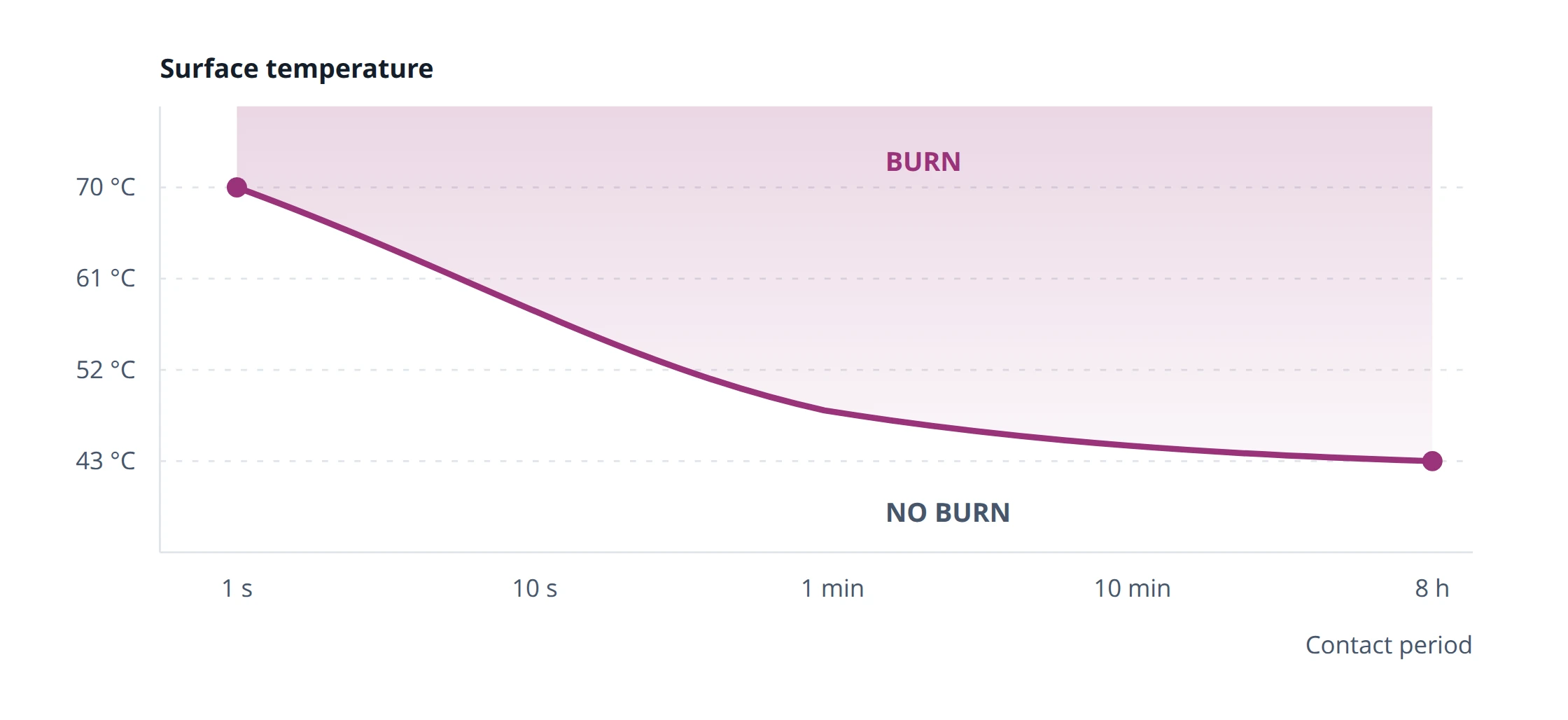
Indicative representation of the burn threshold for bare, uncoated metal as a function of contact time, based on the threshold values given in EN ISO 13732-1. [1] Redrawn; not a reproduction of the figures in the standard. For saturated steam at 8 bar(g) the pipe surface sits around 175 °C — roughly two and a half times the one-second threshold.
A one-second brush against an uninsulated steam valve is enough. The reason this does not show up in most plants’ statistics is that it usually does not become a lost-time accident. It becomes a near miss, or a small burn treated at the first-aid box.
Reducing the surface temperature of the hot component with suitable insulation is one of the recognised protective measures against this hazard — alongside guarding, signage and training, and generally more durable than any of them, because it does not depend on a person behaving correctly under time pressure. We all know how it goes: a bad day, one moment of lost focus, and the accident has already happened.
When the danger is visible
Fittings are routinely left out of the insulation scope, because they have to stay visible for fault detection and accessible for maintenance. That is a reasonable decision, and it is also why minimising the consequences of a failure matters so much.
Measures already exist for this: deflector plates, shields, the familiar barriers and fencing, and other ways of preventing access. But they bring back the same trade-off. They reduce the working area, they delay the detection of a fault, and they make the problem harder to resolve once it appears.
When a release does occur, the heat reaching the skin is not the only concern. What is in the medium matters too. Textile processing uses chemicals for dyeing and for stiffening fabrics and products, and some of those have serious adverse health effects.
Roadmap to Zero (ZDHC) is a voluntary industry initiative aimed at bringing chemical discharges at individual manufacturing sites to zero. [3] OEKO-TEX certification is voluntary as well, but a significant share of its limit values derives from binding legislation: REACH Annex XVII (azo dyes, nickel, chromium(VI), phthalates, PFAS), the POPs Regulation and the Toy Safety Directive. Those have to be met with or without a certificate. OEKO-TEX goes beyond them and packages the whole set into a verifiable system.
STeP by OEKO-TEX
One member of that family certifies the facility rather than the product. STeP by OEKO-TEX covers the manufacturing site — from fibre production through spinning, weaving and finishing to garment make-up — and can be extended to warehouses and logistics facilities. [2] It evaluates six modules:
Chemical management
Environmental performance
Environmental management
Occupational health and safety
Social responsibility
Quality management
The assessment begins with an online questionnaire and concludes with an on-site audit. The facility receives a score for each module and an overall rating on a three-tier scale, from Level 1 (entry) to Level 3 (outstanding). The certificate is valid for three years and is a prerequisite for carrying the MADE IN GREEN label on products.
Its weight in the industry comes from the fact that major brands often accept it in place of their own supplier audits, and that STeP-certified facilities are eligible to take part in the ZDHC Supplier to Zero programme.
This matters commercially, not just technically. Sustainability is rising up the agenda for reasons beyond cost: consumers increasingly look for credible green credentials, and they have learned to recognise voluntary certifications — often by the pictogram or the name alone — and to treat them as a condition of purchase. In the textile industry the value of these standards keeps growing, and DYNOTEQ’s experience across sectors helps plants reach them.
Two products, two different hazards
DYNOFLEX® | DYNOGUARD® |
|---|
The two belong together: one manages the constant, everyday exposure; the other manages the rare event that is severe.
The calculation, and who accepts it
We do not quote a saving we cannot show the arithmetic for. Our heat loss calculation follows ISO 12241:2022 [4] and is documented item by item, so the customer can check every assumption — surface temperature, ambient temperature, emissivity, operating hours. Our documentation also follows the TIPCHECK reporting guideline developed by the EiiF (European Industrial Insulation Foundation) which accepted worldwide, especially in Europe.
ISO 12241:2022 | TIPCHECK | 3 countries |
|---|
That documentation is not only for the technical file. The calculation method has been adopted in Hungary, Slovenia, and Poland as the foundational document for energy efficiency accounting, which means that the savings achieved through this method can be included in the relevant national program and reflected in the project costs as a subsidy or reimbursement, thereby reducing the payback period.
The question for plant owners
Textile plants are not badly run. The processes are mature, the production lines are well implemented, and the people who run them know them thoroughly. That is precisely why energy efficiency is a hard sell here — there is no obvious problem to solve.
So the question is a different one.
1. When did you last measure the surface temperature of the fittings your operators pass within arm’s reach, rather than assume it?
2. How many small burns and near misses at the ironing and dyeing stations actually reach your safety report?
3. If a thermal oil flange let go tomorrow at head height, where would it spray?
If the answer to any of these is “we don’t know” — that is the starting point. And it is a measurement, not a purchase. |
|---|
References
[1] EN ISO 13732-1:2008 — Ergonomics of the thermal environment. Methods for the assessment of human responses to contact with surfaces. Part 1: Hot surfaces (ISO 13732-1:2006).
[2] STeP by OEKO-TEX — oeko-tex.com/en/our-standards/oeko-tex-step/
[3] ZDHC Roadmap to Zero — roadmaptozero.com
[4] ISO 12241:2022 — Thermal insulation for building equipment and industrial installations. Calculation rules.
* Artificial intelligence tools were used to support the research for this article.